All posts in Cambodia

Public order bill in Uganda

An interesting article on the Public Order Bill in Uganda. The theme - the use of legislation to crackdown on government critics and to exercise greater control over people’s rights to assemble and protest - is familiar. While working in Cambodia over the summer, I analyzed and studied the Cambodian Peaceful Assembly bill, passed in 2009, which has similar provisions (see pages 10-11 of this report & an article I wrote a few months ago). In particular, the establishment of procedures is susceptible to abuse.

Mpagi, writing in the Ugandan Monitor:

According to the explanatory memorandum for the Bill, it among others “seeks to manage public order” and to “specify the procedure to be followed when organising an assembly, a procession or demonstration as well as the penalties and sanctions to be imposed upon those found to breach the proposed law.”

Mr Solomon Webaalearaali, a human rights lawyer with Street Law Uganda, says that alone means that government is seeking to take away what ideally is the essence of demonstration as a means of expressing dissatisfaction in a democratic society.

“Public demonstration has an element of spontaneity, but this law will seek to establish procedures like applying for permission to demonstrate and if you are denied by the police then you go through an appeal process and then a court process; that takes away the purpose of demonstration, imagine people wanted to demonstrate because they took a mother to deliver in Mubende and she was not attended to and she died, do they have to wait and go through all those processes?”

Of course, the rule by law issue is at the heart of the debate. Is the government using new legislation to consolidate its power in the face of protests while placing itself above the law?

Critics of the Bill say these provisions effectively take away any automatic right for people to assemble and questions government actions or inactions. Those jittery about the Bill in its current form say they are concerned that government is increasingly resorting to rule by law rather than rule of law. They argue that the spirit of the new law is a panicky reaction to increasing public pressure on government expressed through demonstrations especially over the last six years.

Cambodian Government Uses NGO Law to Silence Critics

I just published an article which is basically an abstract of the major essay I wrote on ‘repressive legislation’ in Cambodia as a conclusion to the internship. You can view the original here and an abstract below:

In late July the Cambodian government released a third draft of its highly contentious Law on Associations and Non-Governmental Organizations (NGO Law). A number of provisions in the law have the potential to impair the activities of human rights and civil society actors in the country.

The draft law, in a likely violation of freedom of expression which is protected both in the Cambodian Constitution and the ratified International Covenant on Civil and Political Rights (ICCPR), makes it mandatory that any group of Cambodians (including clubs and networks) operating as a non profit in Cambodia register with the government. These bodies also have to fulfill a number of complex and technical registration requirements. If they fail to do so, the government has a ‘legitimate’ excuse to prevent them from operating. The Cambodian League for the Promotion and Defense of Human Rights (LICADHO), a human rights organization operating across Cambodia, dubs this approach the “tyranny of the technicality” and believes it is likely that the government will use this power to shut down entities advocating for human rights or reporting on government corruption.

For ‘informal networks’ or loosely associated groups of individuals like farmers and taxi drivers, who do not have the means to open bank accounts or have formal office addresses, these requirements could severely impair their ability to register. It may force a majority of them to operate illegally, rendering them even more vulnerable. These networks are key partners in the development process, providing first-hand information on the situation of at-risk groups in the country and assisting international donors who continue to fund about half of the Cambodian government’s budget.

While these concerns may seem speculative, there have already been a number of recent situations foreshadowing what is to come. For example, the Ministry of Interior, without any clear justification, arbitrarily closed an NGO called Sahmakum Teang Tnaut (STT). A few weeks before, the NGO had published a report finding that the compensation offered by the government to households affected by a government railway project and slated for resettlement was too low.

LICADHO’s director, Naly Pilorge, perhaps best summarized the overall effect of the NGO Law were it to pass: “Everything that would happen to informal networks under the draft law is already happening now [like STT being shut down]. If the law passes, it legalizes these restrictions.”

Repression through new laws

Activists believe the NGO Law is representative of a larger trend by the Cambodian government to use ‘repressive’ legislation to impair freedom of expression and assembly.

During his recent unofficial visit to the country, Frank La Rue, the UN Special Rapporteur on freedom of expression and opinion, dubbed this emerging Cambodian style of governance a “legal dictatorship.” Surya Subedi, the current UN Special Rapporteur on the situation of human rights in Cambodia, has called it a “legal offensive.”

Along with the NGO Law, the new Penal Code and the Law on Peaceful Assembly also facilitate this trend of repression through the courts in Cambodia.

Commenting on the Penal Code, the Cambodian Minister of Information, Khieu Kanharith, said: “Before, using the argument of ‘freedom of expression’ and opposition party status, some people could insult anybody or any institution. This is not the case now.”

Human rights bodies in Cambodia are particularly concerned by the possibility that Penal Code provisions like incitement to commit a felony and defamation will be indiscriminately used to silence activists in the same way the crime of disinformation under the former UNTAC Criminal Code was applied.

Two recent cases justify this concern:

A LICADHO staff member was charged with incitement during his appeal hearing in July. Originally charged with disinformation for distributing anti-Vietnamese pamphlets, the judge not only violated international fair trial standards, but also clearly affirmed that the court believes that this type of political leafleting can actually constitute an act to cause unrest in Cambodia or ‘incitement.’

A second case is that of Seng Kunnaka. In December 2010, Kunnaka, an employee of the World Food Program, was convicted on a charge of criminal incitement under the new Penal Code for printing and sharing material from KI-Media, an online blog that aggregates information critical of the government. He was sentenced to six months in jail and a $243 fine.

The third ‘repressive law’, the Law on Peaceful Assembly, is primarily giving the authorities a means to isolate and neutralize protests. The law provides for the creation of “Freedom Parks” across Cambodia. These parks are assigned zones for peaceful protests of up to 200 people. They are typically isolated from heavily trafficked areas. Authorities use the existence of these parks as an excuse to disperse peaceful assemblies not happening within their confines.

[Continued]

Third draft of the Cambodian Associations & NGO law out

Last week, the Cambodian government released a third draft of the Associations & NGO law. LICADHO’s commentary on this draft of the law can be accessed here. The International Centre for Not For Profit Law (ICNL) has also released a brief analysis available here. In summary, the key issue - the fact that it makes registration mandatory - remains.

LICADHO makes the following recommendations:

• Registration must be voluntary. The law’s mandatory registration provisions violate Cambodia’s own Constitution, international norms, and multiple international conventions which Cambodia has ratified. It also puts the NGO Law in direct conflict with several other Cambodian laws, creating a confused, impossible-to- navigate legal landscape for all groups wishing to assemble or undertake a broad array of activities in Cambodia.

• The law should specify that organizations and associations are temporarily authorized to operate while their registration applications are pending.

• The government must articulate a justification for the law, particularly in light of Cambodia’s 2007 Civil Code. The current stated purposes in Article 2 are entirely unsatisfactory: “giving” rights that Cambodians already possess, and providing opportunities that already exist.9 Stating a coherent justification will allow Cambodia’s legislators the ability to assess the stated purpose of the law and determine whether it is merited or whether modifications are warranted.

The law has moved to the Council of Ministers, which in Cambodia is the final stage of review before a law moves to the National Assembly for ‘debate’ (Hun Sen’s party, the Cambodian People’s Party has a majority and it is highly unlikely that the debate would lead to the necessary amendments, or anything else fruitful). For more updates on the law, “like” the Oppose the Cambodian NGO & Associations Law page.

Voice of Democracy Internship

For anyone interested in radio/media in Southeast Asia, I would highly recommend checking out this opportunity. If you are interested, please let me know.

Internship with Voice of Democracy, Phnom Penh

Responsibilities:
- Assist the team in updating the current website (www.vodhotnews.com & www.ccimcambodia.org);
- Promote the websites;
- Develop strategic plan for mobilizing visitors and long-term sustainable operation, including online income strategy;
- Develop proposal to upgrade the website and expand online activities;
- Build capacity of the team in running the website (eg. web security);
- Edit English content for online positing
Requirements:
- Communications and/or journalism background
- Experience with web development
- Be willing to relocate to Phnom Penh for a minimum of three months
- Have an interest in human rights issues

WoK in Cambodia’s F Magazine & beads in Phnom Penh

Women of Kireka featured in Cambodia’s F Magazine:

And a beautiful package of beads just arrived from Dallas, Texas. Let me know if you are in Phnom Penh and interested:

LICADHO employee, Leang Sokchouen, at the Phnom Penh Court of Appeal

Leang Sokchouen at the Phnom Penh Court of Appeal. Photo by LICADHO.

Yesterday, I attended Leang Sokchouen’s trial at the Phnom Penh Court of Appeal. Sokchouen is a LICADHO employee who was charged with disinformation (under the UNTAC Penal Code) in September 2010. Here an extract of the LICADHO press release issued after the trial court ruling:

Sokchouen was accused of distributing anti-government fliers in Takeo Province on January 4, 2010. Sokchouen was a longtime acquaintance of co-defendant Tach Khong Phoung, but consistently testified that he had no knowledge on the flier incident. The so-called evidence provided by the police against Sokchouen consisted of a simple list of phone numbers claiming Sokchouen and Tach Khong Phoung had called each other.

Another defendant, Tach Vannak, initially claimed while detained at the Ministry of Interior’s National Police that Sokchouen was involved in distributing the fliers.

However, Vannak retracted part of his statement in court yesterday, saying that he only implicated Sokchouen because of false promises made by police interrogators. He claimed police promised him that he would be allowed to go back to his family in exchange for his cooperation.

(…) The prosecution produced no in-court witness testimony or evidence. The judge relied entirely on written statements and four alleged witness statements from police officers. None of these individuals were ever called to court by the investigating judge.

By all appearances, the investigating judge did not do any investigative work on the case whatsoever. This is contrary to the spirit of Article 127 of the Code of Criminal Procedure, which states that an investigating judge “has the obligation to collect inculpatory as well as exculpatory evidence.” This oversight left the trial judge to rely entirely on police investigation report - written before the suspects were questioned or arrested.

Conversely, the Sokchouen’s defense team provided extensive in-court testimony, including evidence that Sokchouen was in Phnom Penh - not Takeo - on January 4, 2010.

The judge stated that in-court testimonies by the three accused “could not be trusted” and based his decision entirely upon the police report and interrogation. Article 118 of the Code of Criminal Procedure states that police reports can be used for “information only,” but that they may also be considered as evidence if they are not “proven false.” Despite strong evidence that the police report was indeed false, the judge failed in his duty to evaluate its veracity. He simply accepted the report as truth.

In appeal, Sokchouen was represented by two LICADHO lawyers, who were given less than 24 hours to prepare. During the hearing, Sokchouen’s lawyers requested bail. However, after a five minute discussion, the judges refused citing possible public disorder. The judges, along with the defence, interviewed Sokchouen. In under two hours - with two of the judges regularly dozing off - the court announced that their final verdict would be communicated on July 14th at 8am. While about 100 people showed up to support Sokchouen, only a small number were allowed in the court room despite it being a public trial.

Sous Chantha, union leader, released from prison

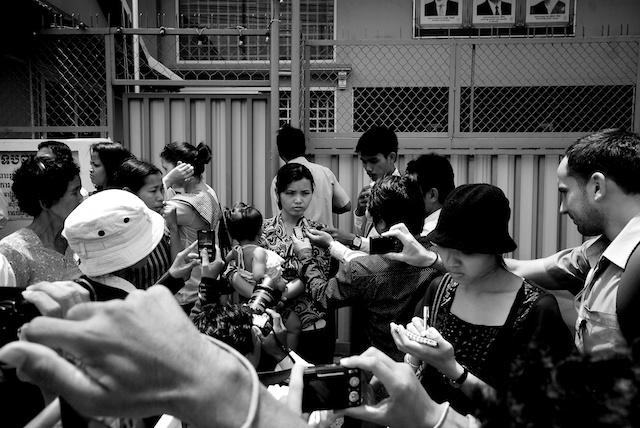
Trade union leader Sous Chantha’s wife holds a press conference after her husband’s trial on Friday, June 24th 2011.

When I first arrived in Phnom Penh, I was invited to attend a ceremony in support of Sous Chantha, a Cambodian union leader. Along with his family and other garment factory workers, we went to a pagoda near CC1 and participated in a Buddhist blessing. A crowd of friends, family and supporters then walked to the correctional center and released balloons. The hope was that Chantha would see them as they floated above the prison walls. At the time, Chantha had been held a month longer than provisional detention allows in Cambodian law (unless there is a formal hearing to renew provisional detention with a maximum of 12 months total).

Yesterday, I attended Chantha’s trial at the Phnom Penh Capital Court of First Instance. Chantha was first accused of drug trafficking, but the charges were eventually lowered to drug distribution (some believe this change happened because it was blatantly not trafficking, others because of pressure from unions and companies buying from Cambodian garment factories).

The facts laid out in LICADHO’s press release shortly after his arrest were confirmed during the trial by Chantha and a garment worker who had witnessed the events (he was on a motorbike behind Chantha when the arrest happened). The garment worker said that the police had beaten Chantha after forcing him off his motorbike. Chantha said the military police had “turned him away” (translation from Khmer) from his motorbike. It is likely that Chantha did not use the same language as the witness in order to not attract more trouble. When Chantha was allowed to turn around again and look at his motorbike, the police shone a flashlight on the back hatch and accused him of having drugs. All Chantha could see was the corner of a small plastic packet near the motorcycle’s battery; the other nine packet of drugs were only revealed to him when he arrived at the police station. Both Chantha and the witness confirmed that there was indeed no roadblock at the time of Chantha’s arrest. Notably, the military police who had arrested Chantha failed to show up at the trial.

In their closing statements, the defense lawyers argued that Chantha could not be convicted for the distribution because this would require evidence of a buyer. Moreover, it was possible to slip a thin plastic baggy of drugs into the back of the motorcycle without actually opening it (i.e. it could have been done in the factory parking lot which is a public space). The defense lawyers also emphasized the suspicious nature of the arrest: it happened shortly after he transferred his union’s 1000 members from the Independent & Democratic Union Federation (IDUF) to the Coalition of Cambodia Apparel Workers Democratic Union (C-CAWDU). The prosecutor argued that because Chantha claimed during the trial to not do drugs at all, by default the drugs must have been meant for distribution.

After about two hours of questioning and an hour-long wait, the judge called Chantha back in and announced the verdict. They found him guilty. He was sentenced to ten months in jail, but ordered only to serve seven months and five days in prison. Since this was the time he had spent in pre-trial detention and the prosecutor decided not to appeal, he was released that evening. As Chantha walked out of the court at midday to be brought back to the prison before being released, he was applauded by a garment factory workers and his family. His father started crying.

From my understanding of the trial (through a translator) there was no evidence to support distribution charges. The following day, the Cambodia Daily reported that “local and international rights groups, including Amnesty International, raised doubts over the charges and said that they seemed to be linked to his union activities. Some said the arrest served to intimidate unionists.” Moeun Tola, from the Community Legal Education Center, was also quoted in the Cambodia Daily: “We’re not happy with the verdict. It’s unfair for him, an injustice for him that he was charged with drug distribution. We still believe his case was set up.” The presiding judge, Din Sivuthy, has been involved in previous human rights cases with suspicious (and “shocking”) verdicts (see this acid attack case and journalist Hang Chakra’s conviction).

Chantha was released from prison yesterday evening. After participating in a Buddhist ceremony, he returned home to his family after having spent over seven months in prison.

This Magazine: “Postcard from Cambodia: How a new law threatens Canada’s aid to millions.”

Just up on THIS Magazine. Based on a previous article published in the Guardian (UK), this post takes a closer look at Canada’s role in the Cambodian draft NGO & Associations Law.


Slate: “Silence of the Lambs: For do-gooder NGOs in Cambodia, accommodation with the regime is very profitable.”

Slate just published a scathing – and refreshing – article on NGOs working in Cambodia. A number of the author’s comments ring true for aid and development work anywhere in the world. In particular,

The point here is not that every seemingly good cause is a fraud and that all international aid groups are poverty pimps (though some certainly are). It’s that people should bring the same degree of scrutiny to NGOs as they do to corporations and governments (and the media for that matter). And nowhere is a jaundiced eye more warranted than in examining the do-gooder community of Cambodia.

Silverstein also highlights the relationship between the corrupt Cambodian government and NGOs. One approach of choice by NGOs is working in the ‘back end’:

Gauntlett declined to comment for this story, but Wildlife Alliance provided a general response: ‘The blame game doesn’t work for groups like us inside Cambodia. We have to be careful and build alliances that are sometimes uncomfortable. It’s delicate because the government can shut down an NGO whenever it wants. But we work on the inside, quietly, and get things done. We’ve been able to get things done and reverse concessions by working quietly inside the government and reminding it of its own legal obligations.’

But, when is this simply just not worth it anymore? Silverstein concludes the article with the following:

The NGOs desperately want access and the basic equation is that the government grants it to them in exchange for their silence about corruption or anything else remotely controversial,” says the Western expatriate who has worked on land issues. “At a certain point you have to ask yourself, ‘Where is this going, and what are we accomplishing?’

Using new laws to impair freedom of expression in Cambodia

This past week I started writing a brief on the use of repressive legislation in Cambodia to restrict freedom of expression and related rights like freedom of association and assembly. With a majority in Parliament, the ruling Cambodian’s People Party has passed or is about to pass legislation that could be used to legitimize their crackdown on human rights defenders, NGOs, journalists and other concerned parties critical of the government.

Penal Code

The new Cambodian Penal Code was passed in December 2010. It replaces the former UNTAC Penal Code. While the new Penal Code does not contain the same UNTAC disinformation clause (which has been used to jail journalists and wrongfully convict other individuals), it creates a number of new crimes susceptible to abuse. This includes a provision for “incitement” which is defined as incitement to commit a crime or incitement of “serious turmoil in society.” Shortly after the passage of the new Penal Code, World Food Program staff member Seng Kunnaka was convicted on the charge of criminal incitement for printing and sharing material from the website ki-media, an online blog critical of the government [Incidentally, as I write this, my access to ki-media is down again. There are rumours the government is having it blocked]. The government is not hiding one of the new Code’s purposes: “Before, using the argument of ‘freedom of expression’ and opposition party status, some people could insult anybody or any institution. This is not the case now,” said the Cambodian Minister of Information.

For a more in-depth analysis of the new Penal Code provisions, check out this report.

Demonstrations Law

The Demonstrations Law was adopted in 2009. It makes it de facto necessary to receive authorization to protest. Demonstrations can be refused if they harm the rights to “freedom and honour of others, good customs of society and national security”. This differs from the ICCPR article which allows for limits on demonstrations only on the basis of “public safety, public order, public health or morals.” Moreover, the law fails to provide judicial redress in cases where authorization is refused. The Centre for Cambodian Human Rights Report also suggests that the law has been used before to crackdown on private meetings. Finally, and possibly the most disconcerting part of the law for the moment, is the creation of “Freedom Parks” across the country. These “Freedom Parks” are areas where protestors can hold protests after providing 12 hours notice. While the parks do not exclude the use of other public venues, there are concerns they may still be used to isolate and neutralize demonstrations.

Anti-Corruption Law

The third law is the Anti Corruption Law passed in May 2011. While a number of corrupt officials have been charged under the law, there are allegations that these charges are more related to factional splits in the ruling party than to corruption in Cambodia. A number of provisions are problematic. In particular, the law does not provide adequate protections for whistleblowers and thus discourages people from coming forward.

Draft Trade Union Law

The draft law contains a number of provisions that offer the government an opportunity to legitimize their crackdown on the trades union sector through the courts. Several articles of the law blatantly violate the International Labor Organization Convention No. 87 (see this article by article analysis of the law). Key concerns include the inclusion of criminal penalties and hefty fines that could be used to threaten union leaders from speaking out against the government. Vague language contained in the law could also be used by the government to curtail freedom of expression. For example, the provision outlawing demonstrations for “purely political purposes” could be used to prevent legal demonstrations or strikes in opposition of government policies.

Draft Associations and NGO Law

This law is currently in draft form, but it is expected that the government will try and pass the law before the end of the year. In violation of freedom of association protected under the Cambodian Constitution and the ICCPR, the law enforces the mandatory registration of associations and NGOs (see this analysis by LICADHO). It also imposes a number of burdensome registration requirements, which would severely restrict the operation of rural grassroots groups with limited resources. It gives authorities unbounded discretion to approve registration applications, with few guidelines to transparently steer these decisions. There is no appeals process if registration is denied. The law is also loosely drafted, giving it an apparently unlimited scope.

In its current form, the law would likely lead to the outlawing of several informal groups which do not want to register with the government or do not have the capacity. These informal networks give a voice to a number of vulnerable groups including sex workers. The likely closure of grassroots NGOs and associations, which provide information to international donors, could impair economic development in Cambodia. With the press muzzled and the private sector often complicit in human rights violations, NGOs are the last body able to report on human rights abuses and corruption in Cambodia.

Apparently a couple of embassies in Phnom Penh (but not the US embassy), when first faced with the Associations & NGO Law, thought it was a perfectly reasonable law to have in place. After all, many Western countries do have some kind of Association and NGO law. What they failed to consider was the Cambodian context. Most importantly, there is no judiciary to enforce the law fairly (see Cambodia’s recent ranking as 35/36 on the World Justice Project Rule of Law Index) or to create a body of precedent that would narrow or at least purposively develop the ambiguity of many of these provisions. Rather, new laws give the government something to point at when they decide to shut down an NGO, move a protest to a Freedom Park or fine a union leader. New laws make it harder to argue that the government is acting out of bounds.

The content and opinions expressed here do not necessarily reflect the views of nor are they endorsed by LICADHO or its affiliates.

Representing human rights defenders in Cambodia

Sunrith Ham, Deputy Director of Monitoring & Protection at LICADHO, works with a number of human rights victims in Cambodia including the Dey Krahorm community (pictured above). Members of the community were evicted from their land in 2009 for ‘development purposes’ and moved to a relocation site. Their former land remains vacant.

At first face, working as a lawyer in Cambodia seems like a disheartening experience. Corruption is endemic: the rich and powerful bribe judges to have cases found in their favor and use criminal sentencing to deter resistance from members of the community. The police, acting under the instruction of the government, often comply in the harassment and arrest of human rights activists.

Someone recently asked me why anyone would continue working within such a broken legal system. I think Sunrith’s story is a good example of how coping with difficult circumstances in the hope of helping suffering individuals starts with a personal decision – one intimately connected to culture and religion. In the end, perhaps change makers are not inspired by a single defining event, but rather an uphill struggle led by instinct.

Sunrith graduated with a legal diploma from a Phnom Penh university in 1997 at the age of 22. The government appointed him as a law clerk in his hometown. As a government employee, he was making $20 USD a month. His first experience with the evolving Cambodian legal system was not a positive one. He recounts how a woman’s child was arrested and arraigned in front of the judges. The mother offered them a bundle of money carefully tied with a rope made from banana leaves. The money had clearly been saved up – diligently, meticulously, through hardwork. She bought her child’s freedom; the judges did not complain.

Religion and culture can deeply influence a person. In Cambodian culture, and particularly in Buddhist families, youth are taught to obey their superiors. But, Sunrith was different. He felt he had received two messages: to listen to people older than him; but also to question decisions like those made by the judges at the provincial court. He says his religion, Buddhism, also helped him make the difficult decision to leave his clerking position: “I didn’t feel like I was doing a good thing. I felt that if I was not making people feel better, I was not taking the right route.”

His parents were surprised by his decision. As a class-conscious family in a class-conscious society, they were delighted that their son had found work with the government. Despite this family pressure, he left this position to permanently move to Phnom Penh, the country’s growing capital, some 160 km away.

Sunrith’s first job was as a typist. At first, he was content. He was financially independent as the new job paid more than the government. However, after a few months, he began questioning his decision: should someone with a diploma in law work as a typist? Could he push himself to do more?

Soon he decided to leave his relatively comfortable position as a typist and began volunteering and then interning withLICADHO. He spent the first five years working with the Prison Office. Cambodian prisons, notorious for their horrific living conditions, became a second home to him. While others would express fear or disgust towards prisoners, Sunrith was happy to talk with them, bringing them bananas to help the day past faster. Seeing people energized and rewarded by his presence clearly made him happy.

Eventually, Sunrith transferred to LICADHO’s Human Rights Monitoring Office and this helped him make the decision to become a practicing lawyer. “You see injustice from case to case, but as an observer [a human rights monitor who tracks human rights abuses] you cannot express yourself, you are not in the system.”

Sunrith says that some days he is exhausted and considers leaving the legal profession. Yet, his friends and colleagues convince him that if he stops working, human rights defenders will have a difficult time finding a trusted lawyer to represent them free of charge. Around LICADHO, Sunrith has the reputation of a formidable lawyer: someone with a chilling confidence in front of the Cambodian Supreme Court, the country’s highest judicial body.

While he acknowledges that changing old societal practices would be difficult, he does believe that he can help change the attitude within the courts in Cambodia. To fight corruption and injustice, Sunrith hopes that the next generation will not be taught to accept the orders of their superiors, but rather to question authority. He says that future legal professionals should not concentrate on whether or not there is law, but rather on implementing the existing law and abiding by the rules set out within.

Working with LICADHO, Sunrith, who has been in the thick of human rights activities in Cambodia since the late 90′s, does note some positive changes. He says that the number of political killings has decreased substantially. Rather, the government is now using the courts to dissuade people from challenging them. The fact that the government’s weapon is no longer primarily the gun, but rather the law, is seen as a step – although a twisted one – forward.

Watching community activism in action also seems to give Sunrith renewed hope. He speaks admiringly of the communities living around Prey Lang forest who came all the way to Phnom Penh a few weeks ago to protest the destruction of their forest. He advises the residents of Boeung Kak lake, another community being evicted from their land, to believe in their struggle. “How can you change injustice? How can you change the attitude of the government? Hope comes day to day, from the people. It does not come from institutions or the policymakers.” He says that while Boeung Kak lake residents may lose their homes, in the end, they have set a fighting precedent that will hopefully grow and overcome the “cancer”of corruption and exploitation ailing the country.

Cross posted on the McGill Centre for Human Rights and Legal Pluralism blog.
Land disputes and violent resistance in Cambodia.

LICADHO sprang into action Thursday afternoon when a stand off between villagers and the police in Kampong Speu Province turned violent (see the excellent Radio Free Asia video clip of the clashes here).

This violence comes in the wake of yet another land dispute. The situation in the province has been tense for years. In December 2009, the Supreme Court ruled against the villagers and awarded Taiwanese-owned Meng Keth Company 65 hectares of their land. Thursday’s clashes happened after the prosecutor, Kuth Sopheang, led “a force of hundreds of armed police and military police” in an attempt to enforce the verdict.

Land grabbing is now one of the leading causes of human rights abuses in Cambodia. LICADHO researchshows that “more than a quarter of a million people have been affected by land grabbing and forced evictions since 2003.” There is little legal recourse for poor citizens. The courts in Cambodia are rife with corruption: unless one can pay off the judge, the chance of winning the case is slim.

In a perverted twist of justice, the government and powerful companies also use criminal sentencing in the court to dissuade further violence. It is not unreasonable to expect that some of the main community leaders in Kampong Speu will be slapped with criminal charges and arraigned in front of the court, even if they were not present at the violence. Fabricated evidence and a bribe would ensure that they are incarcerated. As explained by a lawyer here, this method is used because it destroys community resistance without resorting to bullets or assassinations. Ironically, there has been a slump in the number of politically motivated assassinations; but an increase in politically motivated criminal sentencing. Considering how horrific conditions are in Cambodian prisons, one wonders which is preferable.

The violence that ensued in Kampong Speu was “foreseeable” – and LICADHO warned the prosecutor that he had both the moral and legal obligation to avoid violence by not enforcing the eviction order at that time. But it was also fairly apparent, judging by the atmosphere after these events, that the use of violence by villagers to protect their land is not something that people, generally speaking, are used to (though there have been violent clashes before). Land disputes in Phnom Penh, the country’s capital, have usually not involved such a high level of resistance. LICADHO cautions that the violence may be “a sign of things to come.”

This situation reminded me of a conversation with a friend and activist in Montreal a few months ago. He asked me whether I thought violent resistance should be used in Egypt (this was during the protests in January). I struggled to offer an answer that I could justify. A part of me thought that violent resistance would diminish global outcry as international human rights activists would have a harder time justifying these actions and thus putting the situation on the forefront of national agendas (and, in a place like Cambodia, shaming a country can be an effective stick to force change). However, events in Libya seem to have proven me partially wrong (partially right in the sense that despite a violent resistance, the situation has persisted longer than in Egypt although other factors were at play there.)

It does seem – to be blunt – understandable that those about to lose their land and their only livelihood of rice farming would take up arms, especially since major human rights bodies like the United Nations seem to advocate incremental dialogue with the government and the use of a broken judiciary rather than taking more forceful action. As the Director of LICADHO says in thispress release, “They have been abused by the system at every step of the way - abused by private interests, by armed forces, by the prosecutor and by the courts,” […] “They are at the end of their rope. They have nothing left to lose. What do you expect them to do?”

An acquaintance, who has spent almost a decade in Cambodia, commented on the fact that those facing land evictions, particularly in the rural Provinces, did not have the “luxury” of non-violent demonstrations because there was no one to watch them. It is true that in Phnom Penh demonstrators have the option of drawing a larger crowd that facilitates the essential work of the media and other interested parties. Yet, their urban struggles have largely been unsuccessful whereas after this recent clash, the villagers were able to keep their land - at least temporarily.

It is hard to come to a conclusive response on the role of violent demonstrations in the context of land disputes in Cambodia. However, I do think LICADHO makes an important point: if the government doesn’t take action, if the international community continues to see Cambodia as a mostly stable developing country, and if people are not given a fair forum to resolve these land disputes, one can likely expect that more situations like this will arise.

The content and opinions expressed here do not necessarily reflect the views of nor are they endorsed by LICADHO or its affiliates. This post was first published on the Centre for Human Rights and Legal Pluralism blog.

Dey Krahorm press conference

The following pictures are from yesterday’s press conference held by Dey Krahorm community leaders. The press conference was originally organized to protest the holding of a football tournament on the former Dey Krahorm lands (the community was evicted in January 2009).

With activists having successfully lobbied for the cancellation of the tournament, the press conference turned into an opportunity to celebrate this success. However, it was also clear that Dey Krahorm residents remain frustrated and saddened by the fact that their lands remain empty, despite being kicked off them for “development” purposes.

Their living conditions also remain precarious: one speaker asked NGOs for medicine and food and several children and community members were sick. LICADHO’s Medical Office was able to provide some assistance by coming to the conference and providing medication, as well as helping arrange counselling services.

More information on Dey Krahorm can be found here, photos from the eviction in 2009here and a press release on yesterday’s meeting here.

The content and opinions expressed here do not necessarily reflect the views of nor are they endorsed by LICADHO or its affiliates.

Dey Krahorm: football tournament on stolen land.

For those of you in Phnom Penh, do try and attend this press conference tomorrow morning. For more information on the situation, see this article stub from The Cambodia Daily.

Hello Dey Krahorm friends,

I am Chan Vichet, representative from former Dey Krahorm community.

Dey Krahorm was illegally evicted from our homes on January 24, 2009. This weekend, 7NG company want to host the Bayon football tournament on our former land.

Tomorrow June 3 2011 at 9:00AM, Dey Krahorm representatives will hold a press conference opposite the former DK land (near wall of Russian Embassy) to respond and explain our feelings about the Bayon football tournament being held on our stolen land.

The three point of the press conference is as follows:

1) Dey Krahorm families do not support and are not happy about football tournament on their land. We feel that if the tournament occurs on our stolen land, the tournament and all supporters look down on Dey Krahorm families and ignores their ongoing suffering resulting from the forced eviction.

2) Dey Krahorm families and friend appeal to donors/investors and general public to stop any support or participation in any activities on former land of Dey Krahorm, as this land now covers the tears and blood of the people who previously owned the land.

3) Dey Krahorm families appeal to government to return the land to Dey Krahorm as we are the legal and rightful owners. 7NG made football field to hide their inability to develop on the land in any meaningful way that would justify removal of legal owners of land.

We ask that all DK friends will join in us in Solidarity at this important press conference tomorrow.

Thank you,
Chan Vichet

Happy International Children’s Day!

LICADHO staff getting ready for a visit to Correctional Centre 2.

In Phnom Penh, LICADHO‘s central office celebrated this day by bringing food, soap, and other gifts to young children (who can stay with their incarcerated mothers until they are six) and juveniles in two of Phnom Penh’s prisons, Correctional Centre 2 and Takhmao Prison. Both these prisons have a serious overcrowding problem. For children and their mothers, it is a particularly miserable environment. This report “A review of the conditions of mothers, pregnant women and young children living in ten Cambodia prisons” details these conditions.

takeo province by motorbike.

Visiting Takhmao prison

Originally posted on the McGill Human Rights blog:

Yesterday, I went with the LICADHO Prison Office staff to Takhmao prison on the outskirts of Phom Penh to conduct interviews with inmates and visit Leang Sokchoeun. He used to work with LICADHO, but was arrested in May 2010 and accused of involvement in the distribution of anti-government leaflets. He was charged with disinformation under Article 62 of the UNTAC law. On May 29, 2011, he will have been in prison for one year and is slated to remain incarcerated for another year. Sokchoeun’s mother was with us, bringing her son bags of fruits and vegetables. The government gives each prisoner only 0.70 USD for food per day (to learn more about prison conditions in Cambodia, read Dararith’s story). Like other prisoners, Sokchouen relies on external support to survive. Sokchouen and his lawyers have filed an appeal, but they have not yet received any information on its status.

Continued.

The content and opinions expressed here do not necessarily reflect the views of nor are they endorsed by LICADHO or its affiliates.

LGBT Pride Week in Cambodia: Reconciling Family Norms with Sexual Orientation

In Toward Freedom:

Last week, Cambodia finished celebrating its third official lesbian, gay, bisexual and transgender (LGBT) pride celebration, a week of movie screenings, workshops and other activities organized by Rainbow Community Kampuchea (RoCK).

The celebration of LGBT rights in Cambodia has come a long way. Between 2003 and the first official LGBT pride week in 2009, these celebrations in Cambodia were limited to just one evening a year.

Collette O’Regan, a member of the organizing committee, says that the hosting of such an extensive and well-organized week, like Pride 2011, marks a new beginning for LGBT rights in Cambodia. Previously, it was mostly the ‘men having sex with men’ or MSM community that was organized and supported by donors. This necessarily excluded women and stigmatized transgender and sexual orientation by linking it to HIV/AIDS. “You can imagine what this leads to, including horrific discrimination, violence, self-harm and suicide,” she said.

O’Regan agrees that discrimination towards the LGBT community in Cambodia is not on the same publicly homophobic and violent scale as in other countries (although there are worrying instances of violence, such as the recent beating of LGBT bar owner KyePoirrier). For example, in Uganda, David Kato, a Ugandan LGBT rights activist, was murdered after appearing on the front page of Rolling Stone, a Ugandan newspaper. The newspaper had published a photo of Kato and other people it said were gay under the headline “Hang Them.”

Read the full article here.


Rally in Freedom Park to protect Prey Lang Forest

Photo from LICADHO.

A rally and press conference was held in Freedom Park in Phnom Penh this morning. Members of the Prey Lang community and their supporters appealed to the Government to save the forest. A 6,044 economic land concession has been granted by the Cambodian government to a Vietnamese owned rubber company, CRCK Rubber Development Co. Prey Lang’s residents and supporters believe this is a threat to their livelihood and one of Cambodia’s largest forests. You can read more about the issue here in the Phnom Penh Post and watch this video.

Sous Chantha, Cambodian union leader, still in pre-trial detention

Six months ago, Sous Chantha, Cambodian union leader and former employee of United Apparel Garment factory, was arrested. This arrest happened shortly after he transferred his union’s 1000 members from the Independent & Democratic Union Federation (IDUF) to the Coalition of Cambodia Apparel Workers Democratic Union (C-CAWDU). A brief history of the case can be found here. The gathering today - a ceremony at the adjacent wat followed by the release of balloons outside the prison where Chantha is being detained - marked the fact that he has now spent exactly six months in provisional detention on drug trafficking charges. Information gathered by LICADHO strongly suggests that Chantha was framed in retaliation for changing his union’s affiliation.

Some people at the ceremony were saying that an international boycott of the factory’s products was leading to renewed pressure on the government to resolve this situation. Shortly after Chantha’s arrest, Clean Clothes Campaign posted an “Urgent Action” request here. However, it is not clear from research online whether there is an actual international boycott in progress and what effect this is having. Also, from what I was explained today on the criminal law system in Cambodia, the Court must hold a pre-trial detention hearing now that Chantha has been detained for six months (I believe Article 208 of the Cambodian Criminal Code). In serious cases, they may extend his provisional detention.

Ath Horn, Head of C-CAWDU, speaking before the ceremony at the wat.

Sous Chantha’s daughter.

During the ceremony at the wat.

Sous Chantha’s daughter during the ceremony.

Walking towards the correctional center where Sous Chantha is detained.

Releasing balloons for Sous Chantha to see from within the prison.

The content and opinions expressed here do not necessarily reflect the views of nor are they endorsed by LICADHO or its affiliates.